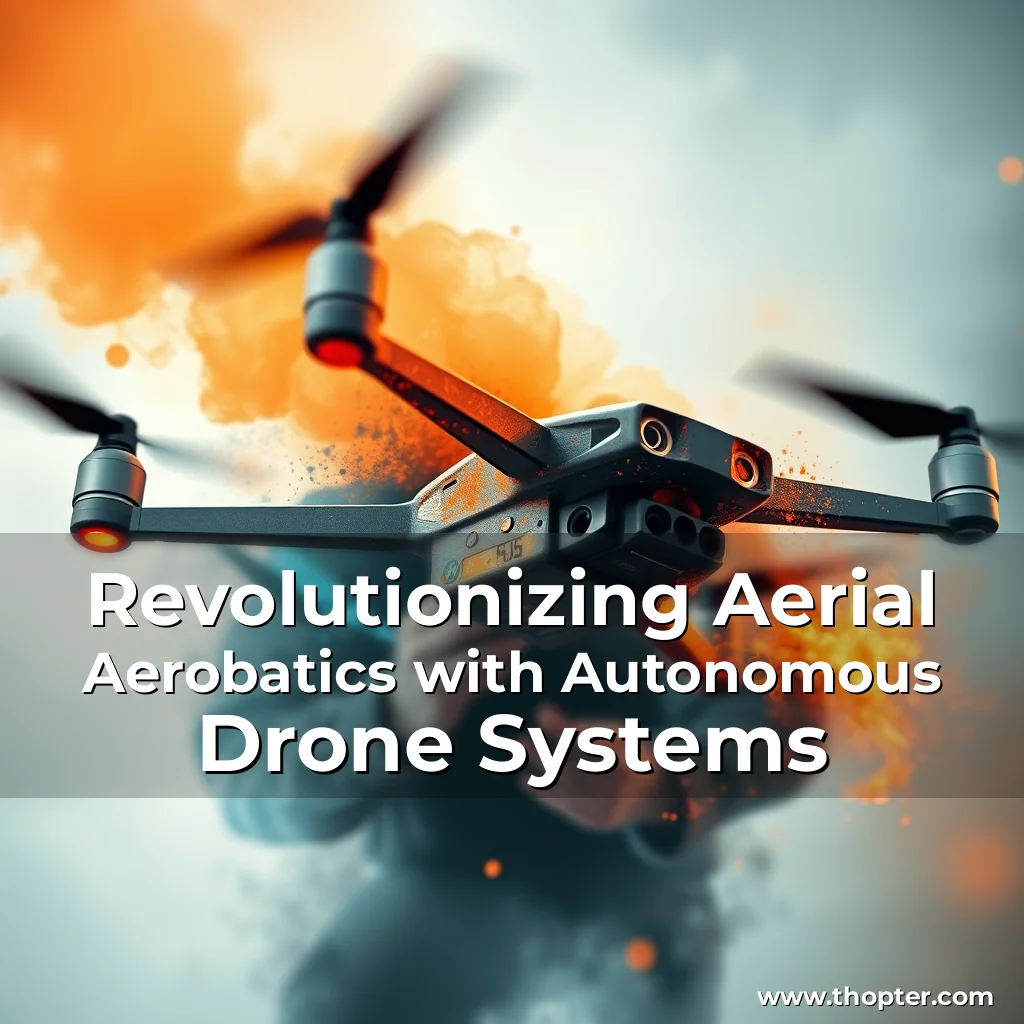
“The algorithms developed by researchers from Zhejiang University enable drones to autonomously perform complex aerial maneuvers such as barrel rolls and power loops, all while skillfully navigating through obstacles.”
Gao Fei, the leader of the research, notes that the biological intelligence of animals such as bats, crows, and falcons has been the inspiration for the development of this innovative system. These creatures have evolved to possess remarkable survival skills, such as aerial stunts, that require precision and adaptability in their natural habitats.
- Natural Wisdom
- Autonomous Drone System
- Aerobatics
- Safety Measures
The breakthrough, published in the journal Science Robotics, has the potential to revolutionize search and rescue missions, allowing drones to navigate through intricate environments with unprecedented efficiency and effectiveness. The system enables drones to autonomously execute complex aerial maneuvers, such as barrel rolls and power loops, while skillfully navigating through obstacles. In outdoor tests, the autonomous drone successfully executed three consecutive acrobatic maneuvers over a 220-meter course without human intervention. The system also demonstrated remarkable precision in confined spaces, such as navigating through 80-centimeter-diameter rings and performing snake-like maneuvers through tunnels.
Achievements of the Autonomous Drone System Feature Description Narrow Obstacle Course Successfully flew backward through 80-centimeter-diameter rings and performed snake-like maneuvers through tunnels. Tracking Accuracy Maintained tracking accuracy within 15 centimeters while flying at a speed up to 7 meters per second. Narrow Gates Achieved a 100 percent success rate navigating through six 1.2-meter-wide narrow gates, while human pilots succeeded only 12.5 percent of the time. The researchers acknowledge that the current system’s reliance on preloaded maps rather than real-time obstacle detection in unknown environments is a limitation. However, their future work will focus on creating fully autonomous systems that can instantly adapt to unknown and changing environments. The technology has the potential to transform disaster response by enabling drones to navigate collapsed buildings or deploy monitoring equipment near volcanic eruptions, and even operate in near-Earth space filled with debris, all through dynamic flight adjustments. As Gao Fei noted, “Smarter algorithms can optimize movement patterns, allowing quadrotor drones to perform more graceful and complex flight maneuvers without the need for hardware upgrades.”
Advantages of Autonomous Drone Systems
• Enables drones to navigate through intricate environments with unprecedented efficiency and effectiveness
• Allows drones to autonomously execute complex aerial maneuvers
• Demonstrates remarkable precision in confined spaces
• Can transform disaster response by enabling drones to navigate collapsed buildings or deploy monitoring equipment near volcanic eruptions
Key Takeaways
• The autonomous drone system has the potential to revolutionize search and rescue missions
• The system enables drones to navigate through intricate environments with unprecedented efficiency and effectiveness
• The technology has the potential to transform disaster response and enable drones to operate in near-Earth space filled with debrisAn autonomous drone system is a type of drone that can operate without human intervention, using advanced algorithms and sensors to navigate and execute complex aerial maneuvers.
Aerobatics refers to the art of performing complex aerial maneuvers, such as barrel rolls and power loops, in an aircraft or drone.
Safety measures refer to the features and protocols implemented in a system to prevent accidents or injuries, such as obstacle detection and tracking accuracy.
news is a contributor at Thopter. We are committed to providing well-researched, accurate, and valuable content to our readers.
You May Also Like