The Growing Use of Drones by Armed Groups
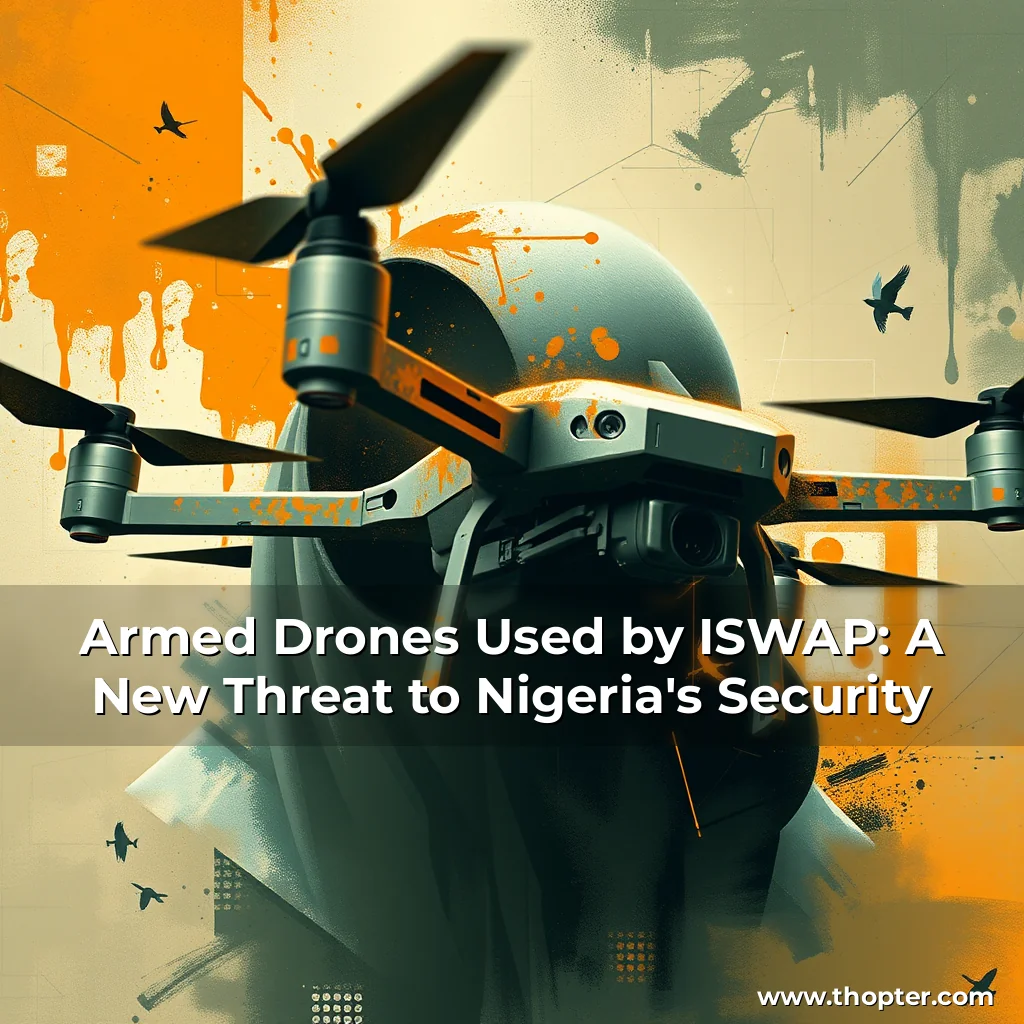
In recent times, the use of armed drones by armed groups such as the Islamic State West African Province (ISWAP) has been on the rise. This marks a significant shift in their tactics, as they increasingly rely on these unmanned aerial vehicles (UAVs) to carry out attacks.
- ISWAP’s use of drones is not limited to surveillance and propaganda; they have also been known to modify commercially available drones, such as quadcopters, to carry out attacks.
- These drones are often equipped with locally-made grenades, which can cause significant damage to military targets and critical infrastructure.
How ISWAP Acquires Drones
The insurgents’ access to high-tech devices has largely been linked to their control over smuggling routes and arms trafficking networks, including looting and sourcing hardware within the country.
- They modify commercially available drones, such as quadcopters, to carry out attacks.
- ISWAP also uses satellite internet and artificial intelligence to edit propaganda materials and enhance their offensive capabilities.
The Impact of Boko Haram Insurgency
The Boko Haram insurgency has had a devastating impact on Nigeria, resulting in the deaths of tens of thousands of people and the displacement of over 2.3 million.
| Year | Death Toll | Displacement |
| 2009 | 20,000 | 100,000 |
| 2015 | 15,000 | 500,000 |
Adapting to a New Strategy
Analysts say authorities must adapt a new strategy that combines technological innovation, military preparedness, and coordination with neighboring countries.
“We need to deploy systems capable of detecting and neutralizing hostile drones. Tools such as jamming devices, radar detection systems, and spoofing technologies can play a vital role in protecting military assets and civilian infrastructure from drone attacks,” said Samuel Malik, who works with Good Governance Africa.
Expert Insights
Vincent Foucher, a research fellow at the French National Centre for Scientific Research (CNRS), noted that the use of armed drones by ISWAP is symbolic and that it’s proof that the group is still very active. “It’s very symbolic,” Foucher said. “This new bout of armed drones is part of that [ISIS-ISWAP technological transfer]. I don’t think it’s a game-changer.”
Taiwo Adebayo, who has been monitoring the war against Islamist insurgents for the Institute for Security Studies (ISS), suggested that the Nigerian state must strengthen its non-kinetic approach to counterterrorism and block the insurgents’ supplies and disrupt their financing. Impact of the use of drones
The use of drones by ISWAP marks a significant shift in their tactics and could further prolong the conflict in the region. Key Points
- The use of armed drones by ISWAP marks a significant shift in their tactics.
- The use of drones by ISWAP could further prolong the conflict in the region.
- The Nigerian state must adapt a new strategy that combines technological innovation, military preparedness, and coordination with neighboring countries.
Resident’s Perspective
A resident, Ijasini Ijani, noted that the use of drones by ISWAP is challenging existing counterterrorism strategies and could lead to decreased confidence in the state military. “It’s not just the guerrilla warfare that we normally experience this time around; they are conducting two forms of attacks. One, looting. Most of the attacks recently are to loot local communities of their goods and properties, and attacking military bases,” Ijani said.
The Sahel region is the epicenter of global terrorism and now accounts for over half of all terrorism-related deaths.
Aerial capabilities refer to the ability of drones to fly and carry out attacks from the air.
Non-kinetic approach to counterterrorism refers to the use of non-violent methods to counter terrorism, such as intelligence gathering, financial disruption, and diplomatic efforts.
Spoofing technologies refer to the use of technologies that mimic the signals of legitimate systems, allowing for the disruption of enemy communications.
Critical National Infrastructure (CNI) refers to the infrastructure that is essential to the functioning of a country, such as power plants, water treatment facilities, and transportation systems.

news is a contributor at Thopter. We are committed to providing well-researched, accurate, and valuable content to our readers.