
- Definition
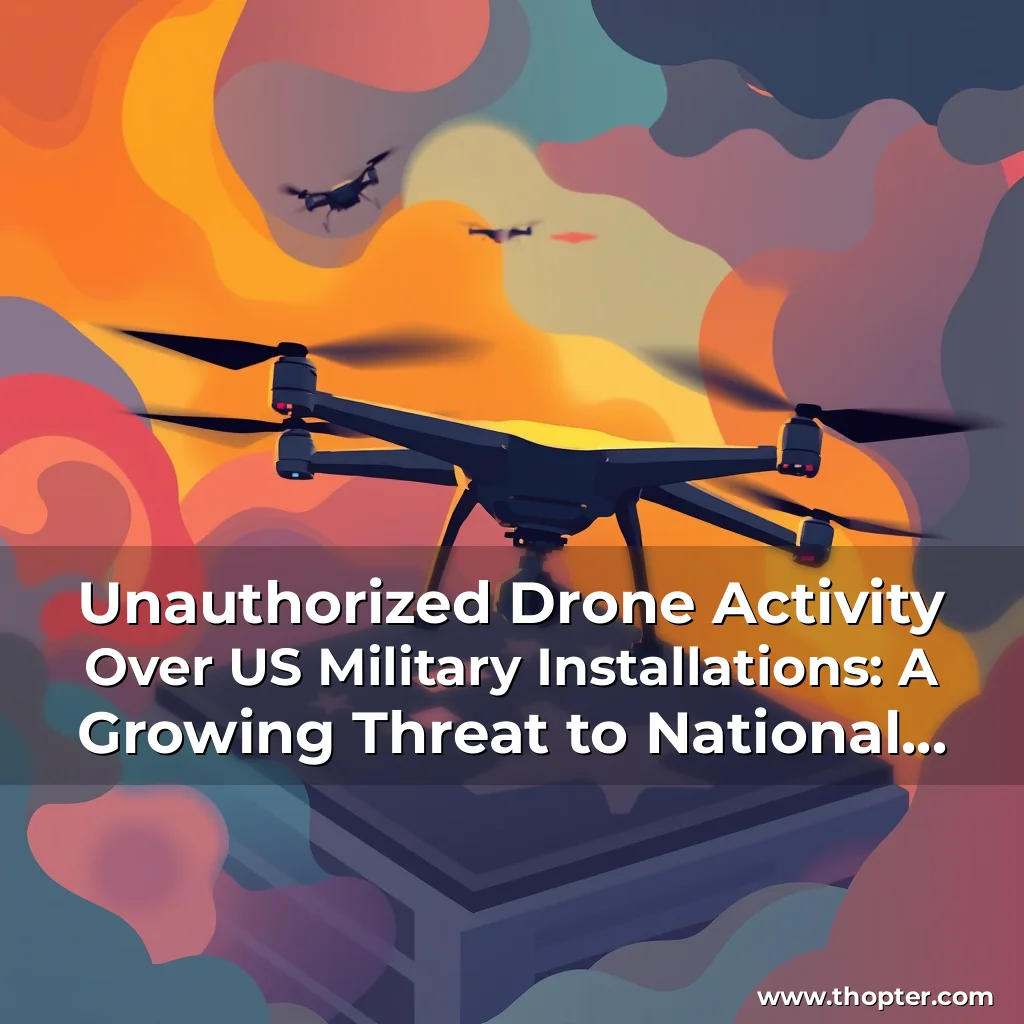
- Unauthorized drone activity refers to the unauthorised use of drones over military installations or sensitive areas.
Unauthorized drone activity over US military installations and sensitive sites has become a significant and complex threat to national security in recent years. The threat was initially perceived as a problem with hobbyists, but it has evolved into a coordinated effort by adversaries to collect valuable intelligence and surveillance on sensitive military equipment. These incursions are often designed to disrupt important training and create chaos. * The problem is not limited to a few isolated incidents, but is a widespread issue that has been detected at over 100 different military installations in the past year. * The sheer volume of drones in the air makes it difficult to detect and respond to unwanted drone activity. * The situation is exacerbated by a lack of clear legal authorities and standard operating procedures (SOPs) to guide responses and decision-making. Despite the challenges, the Department of Defense (DoD) and other agencies are taking steps to address the threat. The DoD has established the Joint Rapid Acquisition Cell (JRACK) and the Joint Counter UAS Office to rapidly acquire new capabilities and develop technologies to counter-drone systems. Some of the key issues facing base commanders and the DoD include:
* Inadequate or non-existent monitoring capabilities, which vary greatly from base to base and are not comprehensive or sufficient. * A near-total lack of counter-drone capabilities, which makes it difficult to respond effectively to drone incursions. * Unclear SOPs to guide responses and decision-making, which can lead to confusion and critical gaps in response. * Ambiguous legal authorities, which can make it difficult to respond to drone incursions on or off base. * The DoD is seeking legislative refinements to their counter-UAS authorities under Section 13i to address some of these issues. * Proposed changes include expanding the locations and missions covered under 13i to include all installations, not just the current nine mission areas. * The DoD is also seeking to facilitate data sharing with inter-agency partners beyond just legal cases, to improve tactics and procedures and drive cost efficiencies. The DoD is also working to modernise its ability to assess threats, determine weaknesses, and acquire and deploy countermeasures. This involves developing and fielding “domain awareness sensors” to track drones, as well as methods for command and control and building a common operating picture by fusing data from different sensor types. The threat of unauthorized drone activity is not limited to the US military. Other countries, including China and Iran, are also using drones to collect intelligence and surveillance on sensitive military equipment. * Two Chinese nationals have already been arrested for illegally flying drones over military installations for surveillance since 2023. * The US government is seeking to prevent foreign adversaries from exploiting existing weaknesses and jurisdictional confusion to carry out malicious activities. In conclusion, unauthorized drone activity over US military installations is a potent, evolving threat that demands urgent attention. While the DoD is taking steps to improve capabilities and processes, significant hurdles remain, particularly concerning legal authorities, technology gaps, and inter-agency coordination. To address this threat, the government needs to take a whole-of-government approach and a unified effort, which involves:
* Modernising the ability to assess threats, determine weaknesses, and acquire and deploy countermeasures. * Providing necessary authorities, appropriations, and oversight. * Streamlining legal and procedural issues to enable effective responses to drone incursions. * Enhancing domain awareness and building partnerships at all levels to secure the skies above America’s sensitive sites. Ultimately, the threat of unauthorized drone activity will only continue to grow if left unchecked. It is crucial that the government takes swift and decisive action to address this threat and prevent malicious activities from occurring.